A website every resident can actually use.
Website builds, accessibility remediation and contract webmaster care for towns, counties and special districts.
There are rules with names and dates attached and we’ll get to those, but the reason to do this is simpler. Right now, a portion of the people you serve can’t get what they need from you online.
Who can’t use it today
Someone with low vision uses software that reads a page aloud. It works well on real text. A scanned agenda is a photograph, and a photograph reads as nothing.
Someone who can’t use a mouse moves through a form with a keyboard. If the fields weren’t built for that, they get partway and stop, and you never hear about it.
An older resident on a phone is looking for a meeting time. If the text won’t grow, or the layout collapses when it does, they call the office instead. That call is staff time, every time.
Almost none of these people file a complaint. They give up quietly. The only signal you get is that the phone rings more than it should.
The part everybody underestimates
The website is the smaller half.
Agendas, minutes, budgets, permit applications, public notices, going back years. Most of them are PDFs and many are scans, which means they’re unreadable to the assistive software some residents rely on. Those are the files that get named when somebody finally does complain.
It’s a project with a beginning and an end, and it takes longer than anyone expects, so it needs to start well before the date it has to be finished.
The rule, and which date is yours
In 2024 the Department of Justice finalized a rule under Title II of the Americans with Disabilities Act. It sets one technical standard for the web content and mobile apps of state and local government, and it puts a date on meeting it.
It applies to cities, counties, towns and special district governments alike.
The standard is WCAG 2.1 Level AA, and it covers the whole public-facing operation rather than the home page: department pages, online forms and payments, and the documents you publish. A PDF on your website is web content under this rule, which is why agendas, minutes, budgets and notices are in scope, and why they’re usually the larger job.
| Entity | Date |
|---|---|
| Population 50,000 or more | April 26, 2027190 days from today |
| Population under 50,000, and every special district government whatever its size | April 26, 2028556 days from today |
Both dates moved once, in April 2026.
They were April 24, 2026 and April 26, 2027. The Department extended each by a year and left the requirements themselves alone. So if you heard an earlier date and assumed you’d already missed it, you haven’t. If you heard the rule was rolled back, it wasn’t.
The exceptions are narrower than people hope.
Archived content is the one most often reached for. It only qualifies if it was created before the rule’s date, is kept purely for reference or recordkeeping, sits in a part of the site set aside for archives, and hasn’t been changed since it was put there.
Neither date is as far away as it sounds.
The document work takes longer than anyone expects, and it has to be paid for out of a budget that’s set months before the year it belongs to begins. Counting backwards from April 2027 through one budget cycle is what makes this a this-year problem for a lot of entities rather than a next-year one.
We’re not attorneys and this isn’t legal advice. It’s the rule as published, and your attorney will have a view on how it applies to you. Read the extension in the Federal Register
How we work through it
Evaluate
We test the site the way people actually use it, including with a keyboard and with screen reading software, and we inventory the documents. You get a written report of what fails and how badly.
Plan
What we’d fix, in what order, and what each phase costs. Worst problems first, so the biggest risk goes away earliest. Work starts when you approve it.
Fix it
The site and the documents, in the order the plan sets. You can watch progress while it runs.
Keep it that way
Every agenda you post afterward is a new document, and six months of those puts you back where you started. Webmaster care keeps it fixed.
What the work covers
What we take on, written the way it would read in a scope of work.
- Website build or rebuild
- A written scope, page by page, approved before any work is booked. A fixed price that changes only when you change what’s in it, and a finish date inside the fiscal year. Accessibility is built in from the start, and everything we build is yours when it’s done, whoever hosts it.
- Document remediation
- Agendas, minutes, budgets, forms and notices rebuilt as tagged, readable PDFs, worst problems first, in the order the approved plan sets.
- Webmaster care
- A contract webmaster for the site after launch. We host it, keep it updated, make the changes your staff send, fix what breaks, and check every new page and document for accessibility before it goes up. You get a quarterly summary of what changed and what needs attention. It runs as an annual agreement that renews with the fiscal year, and a new site can be paid for inside it over a fixed term, which is often easier to approve as a monthly line than as a one-time cost.
Work you can check
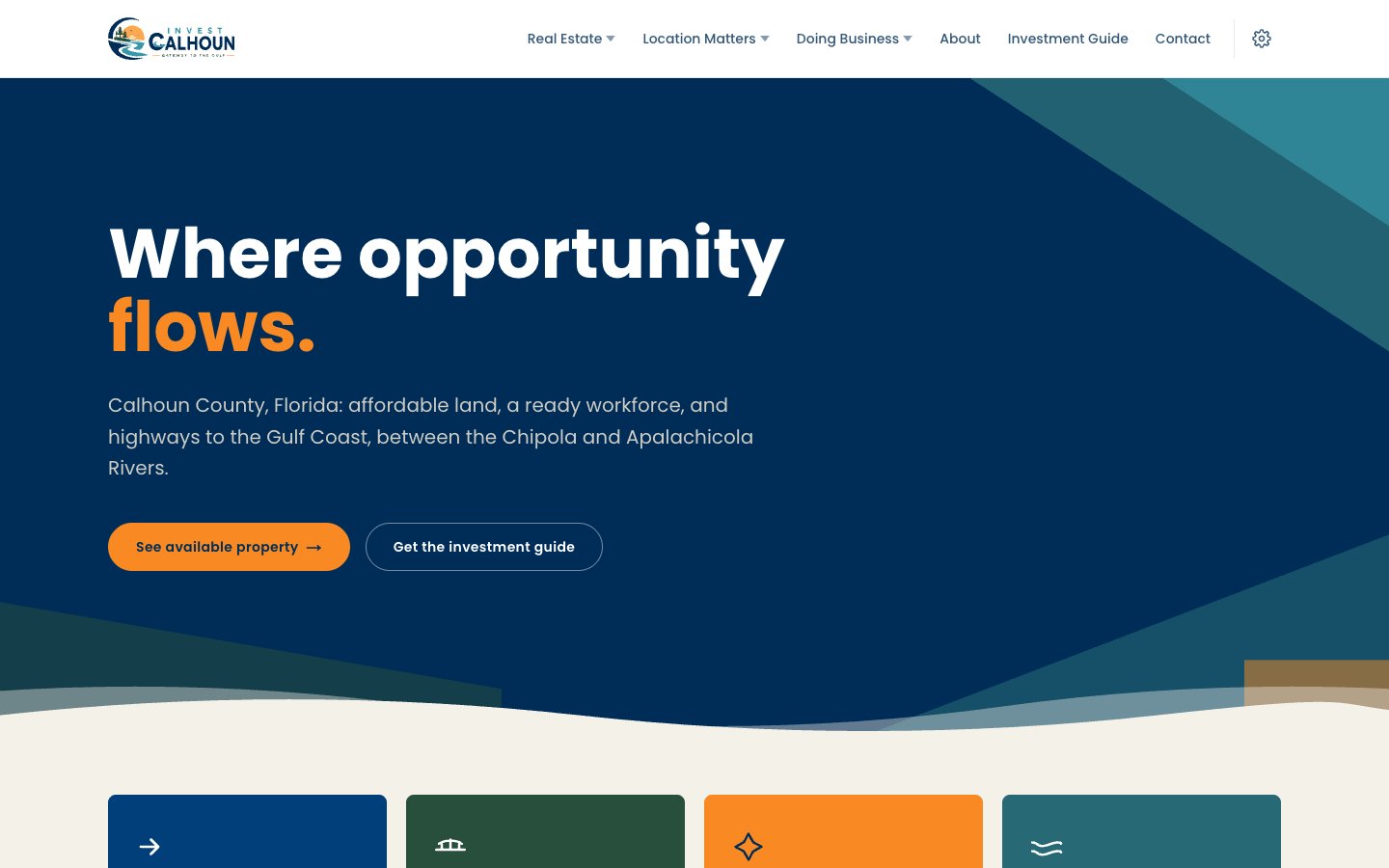
Invest Calhoun is the economic development site we built for the Calhoun County Chamber of Commerce. Ask us for a reference and you’ll get one.
Read what it involved →How we work with public entities
We understand that council approval is required above one threshold and a formal solicitation above another, and we can tell you early which one your project is going to be.
If you’re evaluating vendors
Everything a scoring reader came for, in one place.
- Approach
- Business analysis first. Requirements are gathered from the staff who run the site and documented for your approval before any build work is priced.
- Standard
- WCAG 2.1 Level AA, the technical standard named in the ADA Title II rule for web content and mobile applications.
- Deadlines
- April 26, 2027 for entities serving 50,000 or more. April 26, 2028 for entities under 50,000 and for special district governments.
- Method
- Automated testing across the site, manual keyboard and screen reader passes on representative pages, and review against the Level AA success criteria. Findings are reported per criterion with severity and remediation effort against each.
- Ongoing care
- Contract webmaster services under an annual agreement that renews with the fiscal year: hosting, updates, content changes, repairs, and an accessibility check on every new page and document before it’s published. A quarterly summary of what changed and what needs attention.
- Documents
- Remediation to tagged, readable PDFs with real headings and table semantics. Scanned files are rebuilt as real text.
- What you receive
- An evaluation report, a prioritized remediation plan, a record of the work performed, and a published accessibility statement. There’s no certification body for this, and anyone offering you a certificate is selling something that doesn’t exist. The record of the work is your evidence that it was done.
Where to start
Tell us your website address and roughly how many documents are on it. We’ll come back with what we’d look at first, what fixing it involves, and what it would cost for the year, written as a scope of work you can attach to a purchase order.